How to Read Sheet Music for Brass Instruments
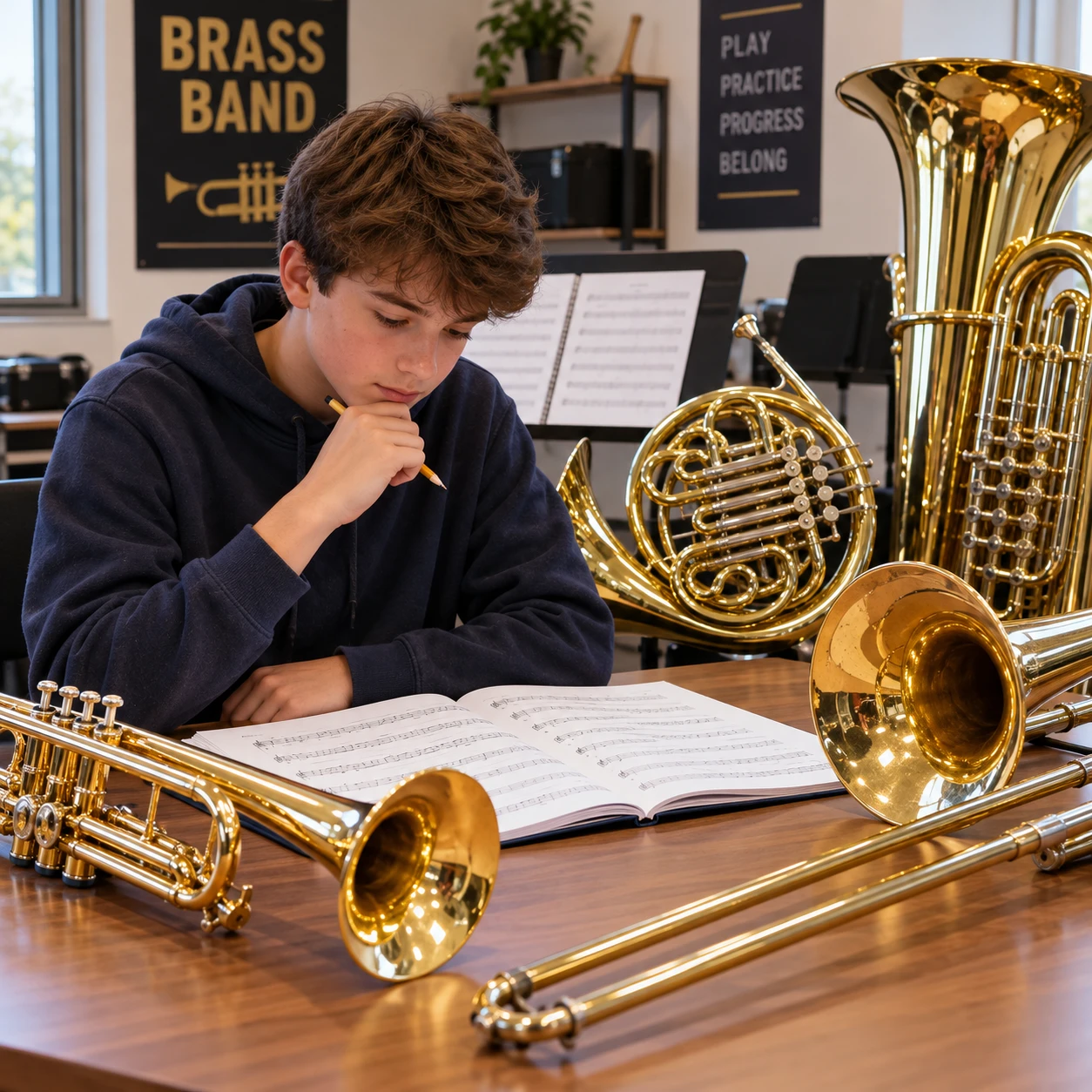
Reading sheet music for brass instruments means connecting the marks on the page to pitches, rhythms, and musical expression. Once you know how the staff, clef, key signature, and time signature work, you can follow your part with more confidence and hear how it fits into the band.
Brass parts can differ by instrument: some use different clefs, and some are written for transposing instruments. Start by reading the part prepared for your instrument, rather than assuming every written note has the same sounding pitch.
Start with the staff, clef, and note names
The staff is a set of five lines and four spaces that shows pitch, while the clef tells you which notes those positions represent. Brass players use the clef printed on their part to identify each note.
In treble clef, the lines from bottom to top are E, G, B, D, and F; the spaces are F, A, C, and E. A common memory aid for the lines is “Every Good Band Deserves Fans,” though learning the note names directly is more useful over time.
In bass clef, the lines from bottom to top are G, B, D, F, and A, and the spaces are A, C, E, and G. Notes above or below the five-line staff use short ledger lines. Read their position in the same stepwise pattern as the notes on the staff.
Many trumpet, cornet, and flugelhorn parts use treble clef. Trombone and tuba parts may use bass clef, while horn parts commonly use treble clef. Brass band conventions can vary, so check the clef at the start of every line, especially when reading a new arrangement. Match a printed note to its staff position first; identify any transposition afterward.
Learn note values, rests, and the beat
Note values show how long to play a sound, and rests show how long to stay silent. Their durations are counted in relation to the beat established by the music.
In a simple meter such as 4/4, a quarter note usually lasts one beat. A half note lasts two beats, a whole note four, and an eighth note half a beat. A dot after a note or rest adds half of its original value: a dotted half note lasts three quarter-note beats.
- Quarter note: one beat in 4/4.
- Eighth notes: usually two notes fit into one beat; a beam or flag groups them.
- Half note: two beats in 4/4.
- Rests: use corresponding symbols to mark silence for a set duration.
Count aloud before playing. For four even beats, say “1, 2, 3, 4.” For eighth notes, divide each beat evenly: “1 and, 2 and.” A brass player should keep counting through rests, since the next entrance depends on the beats that pass in silence. If a rhythm feels uncertain, clap it or tap it on your leg before adding the instrument.
Understand key signatures and accidentals
A key signature shows which notes are usually sharp or flat throughout a piece or section. Accidentals change the pitch of individual notes when the music calls for an exception.
Sharps raise a note by a semitone, while flats lower it by a semitone. The key signature appears after the clef and applies to the named notes throughout the measure and, by convention, across the piece until a new key signature appears. For example, if the signature has B-flat, each written B is played as B-flat unless an accidental changes it.
An accidental appears immediately before a note. A natural sign cancels a sharp or flat; a sharp or flat can also alter a note from the key signature. In standard notation, an accidental generally remains in effect for that same pitch and octave through the measure, then resets at the next barline.
When you see a new passage, pause to identify its key signature rather than trying to remember every altered note while playing. Marking or mentally noting the affected lines and spaces can help. In a band rehearsal, also listen for how your note fits the chord: that supports accurate playing, but it does not replace reading the written accidental.
Read time signatures and rhythms
A time signature tells you how beats are grouped in each measure and which note value represents one beat. Follow it to count bars and place notes accurately.
The time signature sits near the beginning of a part, after the clef and key signature. In 4/4 time, the top number means four beats per measure and the bottom number indicates that the quarter note is the beat unit. In 3/4, there are three quarter-note beats per measure. In 6/8, six eighth notes fill a bar, often felt as two larger pulses, each divided into three.
Barlines divide music into measures, which make it easier to track where you are in the score. A useful method is to count the beat numbers evenly, then subdivide only where needed. For instance, in 4/4, a bar with a quarter note, two eighth notes, and a half note fills four beats: count “1, 2-and, 3, 4.”
Do not speed up to catch a difficult figure. Keep the pulse steady and isolate the rhythm first. If the conductor’s beat feels different from your spoken count, follow the conductor and ask how the subdivision should be felt.
Account for transposing brass instruments
Transposing brass instruments sound at a different pitch from the written note, while concert-pitch parts are written at the pitch that sounds. Follow the notation and conventions of your instrument’s part.
For a transposing instrument, the composer or arranger writes notes so the player can use familiar fingering or playing patterns while the instrument produces the intended ensemble pitch. A B-flat trumpet, for example, typically sounds a whole tone lower than its written note. A horn in F sounds a perfect fifth lower than written. The precise convention depends on the part and notation system.
Many brass band parts are written in transposed notation, but arrangements and ensembles may use different practices. Trombone and tuba parts are often in concert pitch, though this is not universal. Check the instrument label and any instructions on the score; do not infer the system from the instrument alone.
For ensemble playing, your first job is to play the note written in your part, with the correct rhythm and expression. If you are comparing notes with a piano, tuner, or concert-pitch score, account for transposition before deciding that the pitches disagree. This distinction between written pitch and sounding pitch prevents a common source of confusion.
Use dynamics, articulations, and other markings
Dynamics and articulation markings tell you how loud to play, how to begin each note, and how to shape a phrase. They turn correctly read notes into a musical line.
Dynamics include p for soft, f for loud, and markings such as mp and mf for moderate levels. A crescendo asks you to grow louder over time; a diminuendo asks you to become softer. These are relative instructions: balance your sound with the ensemble rather than treating a dynamic as a fixed volume.
Articulation signs shape the start and connection of notes. A dot above or below a note often indicates a short, detached sound. A slur connects notes that should be played smoothly without tonguing each one; on brass, the technique may depend on whether the notes are in the same or different partials. A tenuto line asks for a full, sustained note, while an accent marks a stronger attack.
Look for rests, breath marks, ties, repeat signs, and first and second endings as well. A tie joins two notes of the same pitch into one sustained sound; a slur connects different notes. In a brass band, follow the conductor’s cues for releases and entrances, particularly when your part rests while another section carries the tune.
Build sight-reading skills in a brass band
To improve sight-reading, scan a new part before playing, count its rhythms slowly, then perform it at a steady tempo while looking ahead. Short, regular practice helps you connect notation to sound without stopping at every unfamiliar note.
Try this five-minute routine with an easy exercise or a new band part:
- Scan: Check clef, key signature, time signature, tempo, and any repeats.
- Preview: Notice the highest and lowest notes, accidentals, rests, and likely breathing points.
- Count: Clap or speak the rhythm, including rests and subdivisions.
- Play slowly: Keep the pulse even. If you make an error, continue rather than restarting the bar.
- Review: Identify one passage to practise separately, then try the whole line again.
In rehearsal, listen across the band while keeping your eyes on the part. A cornet player might have the melody, while horns, trombones, euphoniums, and tubas supply harmony, counter-melody, or bass movement. Listening reveals how your line fits, but do not let another section’s part distract you from your own rhythm and entrance.
Memorising note names helps, but reading by interval is also valuable. Recognising that a melody rises by a step or jumps a fifth can make sight-reading faster; interval reading does not replace knowing the notes, especially when accidentals or transposition matter. Practise both, and begin with music simple enough to read without tension.
Common questions about reading brass music
Do all brass instruments read the same clef? No. Parts may use treble or bass clef, depending on the instrument and the band’s notation conventions. Check the clef printed on your part.
Why do some brass instruments sound different from the notes written? Some are transposing instruments, so the written pitch differs from the sounding pitch by a set interval. Players follow their instrument’s written part.
How can beginners practise reading rhythms? Count aloud, clap the pattern, and subdivide long or syncopated rhythms before playing them. Keep a slow, even pulse.
Should I memorise notes or read by interval? Learn both. Note names help you identify exact pitches; intervals help you recognise patterns and follow melodic movement.